
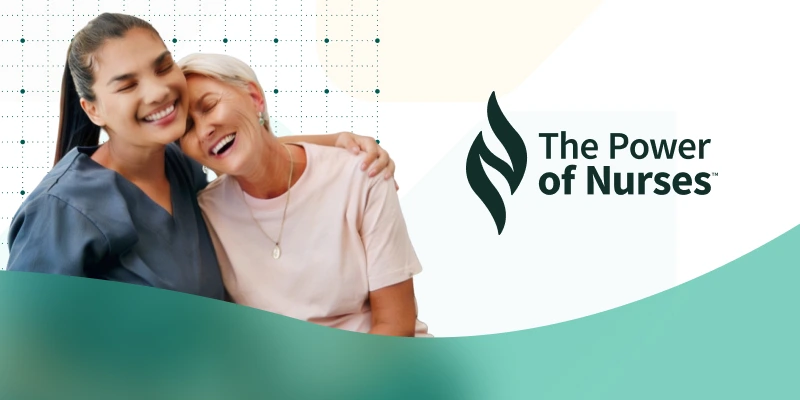
Every year from May 6 to 12, the nursing community and the people they serve come together to recognize National Nurses Week. This year, the American Nurses Association has centered the celebration around a truth that has always been self-evident to those who work alongside nurses: The Power of Nurses.
That power is not found in a single act of heroism, though those moments exist and deserve to be celebrated. It is found in the daily exercise of clinical judgment, institutional knowledge, and professional dedication that keeps healthcare systems functioning and patients safe.
At Prista Corporation, we have the privilege of working with nurses whose contributions to patient safety, quality improvement, and risk management represent some of the most consequential work in healthcare today.
“The power of nurses is found not only at the bedside, but in the insight, leadership, and action that make healthcare safer every day.” – Mendy Acuna, Director of Clinical Applications at Prista Corporation.
Nurses are caregivers, educators, advocates, and leaders. They are often the first to notice changes in patient conditions, the first to identify gaps in care, and the first to raise concerns that protect both patients and staff.
Nonetheless, their contribution does not stop at care delivery. Increasingly, nurses are shaping how healthcare systems think, act, and improve.
The Expanding Role of Nurses in Modern Healthcare
When it comes to healthcare today, complexity is unavoidable. Systems are larger, regulations are stricter, and expectations are higher. In this environment, nurses play a central role in keeping everything aligned.
Naturally, nurses are deeply involved in:
- Patient safety and incident reporting
- Quality improvement initiatives
- Risk identification and escalation
- Compliance and audit preparation
- Care coordination across departments
Despite these responsibilities, their work often goes unnoticed beyond immediate care settings. Yet, behind every well-managed risk, improved process, or successful audit, there is often a nurse who identified a problem early and acted on it.
Clinical Intelligence Meets Patient Safety
Nursing has always been a discipline that blends science with judgment. What is sometimes less visible is how that judgment extends well beyond direct patient care. Nurses working in patient safety, quality assurance, risk management, and performance improvement are the architects of safer systems. They look at data and see patterns before those patterns become incidents. They understand, better than almost anyone, how the environment around a patient either supports or undermines a good outcome.
The nurses who work within quality and safety roles are doing something essential: they are translating the knowledge earned at the bedside into policies, processes, and improvements that protect every patient who enters the system. That work requires not just clinical expertise but leadership, communication, and a genuine commitment to accountability.
What Nurses in Safety and Quality Actually Do
When we think about the full scope of what these professionals bring to their organizations, a few core contributions stand out:
- Identifying risk before harm occurs, through proactive surveillance and pattern recognition
- Transforming complex data into meaningful, actionable insight for clinical and operational teams
- Leading system-wide improvement initiatives and holding processes accountable to patient-centered standards
- Strengthening a culture of safety by modeling transparency, just culture principles, and continuous learning
- Serving as a bridge between frontline care and organizational leadership, ensuring that what happens at the bedside informs decisions at every level
This is the work that does not always make it into press releases or performance reviews. It is, however, the work that makes the difference between a healthcare system that reacts to harm and one that consistently prevents it.
ActionCue CI Was Built With This in Mind
ActionCue CI exists because nurses told us what they needed. Organizations managing patient safety events, near misses, compliance obligations, and quality data require tools that are thoughtful, efficient, and designed to support the humans doing the work. We built ActionCue CI to help nurses and quality professionals do exactly what they are trained to do: turn information into insight, and insight into action.
When nurses use ActionCue CI to document a safety event, track a corrective action, or monitor a trend across their organization, they are exercising the kind of professional judgment that protects patients. We are proud to support that work and to be a trusted partner to the nursing community.
A Thank You That Extends Beyond This Week
National Nurses Week is a meaningful opportunity to express gratitude, and we do so with sincerity. To every nurse working in patient safety, quality, risk, infection prevention, and performance improvement: your work matters in ways that are sometimes hard to quantify but are always deeply felt by the patients and families in your care.
You are not working in the background. You are the people who keep the system honest, keep the data meaningful, and keep improvement efforts moving forward. That is a contribution worth recognizing not just this week, but every week.
Thank you for the work you do. We are honored to be part of it.
Learn more about National Nurses Week 2026!
Here, you can learn how Prista Corporation is helping healthcare heroes in their journey toward better, safer care: